

Your business news from the world
Provided by AGP
R3 Stem Cell Publishes Comprehensive Clinical Review of Intranasal Stem Cell Therapy in Frontiers in Aging Neuroscience
R3 Stem Cell, a top regenerative medicine company, announced the publication of a systematic review by its Research team in Frontiers in Aging Neuroscience.
Intranasal delivery is one of the most exciting and yet under-evaluated frontiers in regenerative medicine. Our review shows compelling early human safety data and intriguing efficacy signals.”
— David Greene, MD, PhD, MBA
SCOTTSDALE, AZ, UNITED STATES, May 13, 2026 /EINPresswire.com/ -- R3 Stem Cell, a leading regenerative medicine organization, today announced the publication of a major systematic review by its Research and Development team in Frontiers in Aging Neuroscience.
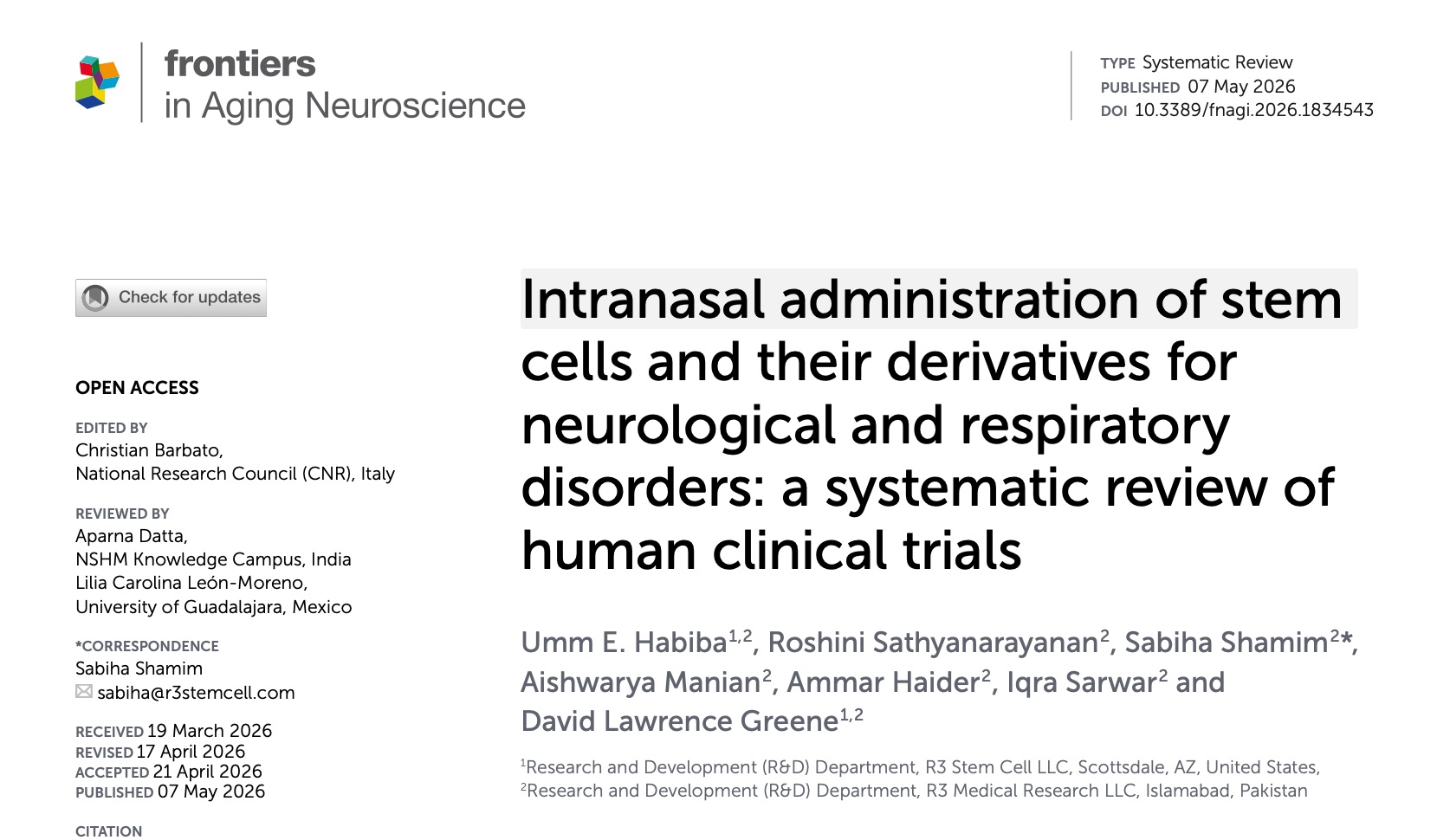
The peer-reviewed paper, “Intranasal administration of stem cells and their derivatives for neurological and respiratory disorders: a systematic review of human clinical trials,” is the most comprehensive synthesis to date of human clinical evidence on a delivery route that many researchers believe could one day reshape how brain disease is treated. The systematic review of 19 clinical studies found intranasal delivery of stem cells and their derivatives appears safe and feasible across a range of neurological and respiratory disorders.
The review — authored by Habiba, Sathyanarayanan, Shamim, Manian, Haider, Sarwar, and Greene — evaluated the safety, feasibility, tolerability, and efficacy of intranasally administered stem cells and cell-derived products from clinical work conducted between January 2011 and December 2025. Searching PubMed, Google Scholar, Web of Science, Scopus, and ClinicalTrials.gov in accordance with PRISMA 2020 guidelines, the team screened 972 records and identified 19 eligible human studies, comprising 7 published peer-reviewed articles and 12 registry-only or grey-literature records.
Patient populations spanned conditions as varied as Parkinson’s disease, Alzheimer’s disease and related dementias, ischemic stroke, cerebral palsy, ALS, refractory focal epilepsy, asthma, and acute respiratory distress syndrome (ARDS).
Across the included studies, the R3 team found that intranasal delivery of mesenchymal stem cells (MSCs), neural stem cells (NSCs), and cell-derived products such as exosomes, extracellular vesicles, and secretome was consistently described as safe and well-tolerated in humans. No serious adverse events attributable to the intranasal route were reported.
Encouraging early signals of efficacy emerged across several trials, including improvements in motor and non-motor symptoms in Parkinson’s disease, gains in gross motor function on the GMFM-88 in pediatric cerebral palsy, and improvements on standard cognitive scales (ADAS-cog, MMSE, MoCA-B) in patients with mild-to-moderate Alzheimer’s disease who received medium-dose MSC-derived exosomes. A separate clinical study of asthma reported improvements in pulmonary function and quality of life. Based on the results, intranasal stem cell treatment for Parkinsons may one day become standard of care with larger studies in the future. Stem cells for Alzheimers as well may become first line treatment with larger clinical trials.
At the same time, the authors are clear-eyed about the limits of the current evidence base. No published trial achieved a low overall risk of bias. Sample sizes were small (median of 13 analyzable participants per published study), most trials lacked sham controls and independent blinded outcome assessors, dose selection was largely empirical, and 63% of identified trials remained registry-only or grey-literature records — well above the 30% threshold the authors flag as indicative of structural publication bias. Human pharmacokinetic and biodistribution data are still missing, and longer-term safety surveillance is needed.
“Intranasal delivery is one of the most exciting and yet under-evaluated frontiers in regenerative medicine,” said David Lawrence Greene, MD, senior co-author of the study and head of Research and Development at R3 Stem Cell. “Our review shows the field has compelling early human safety data and intriguing efficacy signals across a remarkable range of brain and lung conditions - these groundbreaking regenerative therapies are available now with R3, and more clinical trials are gearing up as well.”
The paper also summarizes the mechanistic rationale for the nasal-to-brain route, in which cells and nanoscale exosomes (40–200 nm) travel along the olfactory and trigeminal pathways and can reach deep brain regions within roughly 30 minutes — bypassing the blood–brain barrier that has long frustrated drug developers. It catalogs the technical landscape of intranasal delivery devices, from manual nasal drops and patch-assisted infusion to nebulizers, atomizers, and bi-directional sprays, and reviews dosing strategies ranging from cell-based formulations to exosome preparations of up to several hundred billion particles.
To accelerate clinical translation, the R3 team calls for adequately powered, quadruple-blinded, placebo-controlled randomized trials with sham intranasal controls, independent blinded assessors, pre-registered statistical analysis plans with pre-specified minimal clinically important differences, embedded human biodistribution endpoints using radiolabelled tracking, and tumorigenicity and immune surveillance extending well beyond the typical 3–12 month follow-up windows. The authors also urge sponsors to publish results from completed registry trials to reduce publication bias and strengthen the field’s evidentiary foundation.
The paper appears in the Alzheimer’s Disease and Related Dementias section of Frontiers in Aging Neuroscience, Volume 18 (2026), DOI: 10.3389/fnagi.2026.1834543, and is freely available online as an open-access publication at https://bit.ly/3QXJlAn.
About R3 Stem Cell
R3 Stem Cell is a regenerative medicine organization committed to advancing safe, evidence-based therapies for patients with neurological, orthopedic, autoimmune, and other chronic conditions. Through its Research and Development Department, R3 conducts and publishes peer-reviewed research aimed at translating regenerative medicine into rigorous, accessible clinical care.
R3 Stem Cell operates regenerative medicine clinics at 80 locations in 8 countries. There are stem cell clinics in Mexico, Pakistan, India, South Africa, USA, Turkey, UAE, and Philippines. R3 is the world's largest provider of regenerative therapes with over 28,000 stem cell procedures in the past decade that have an 85% patient satisfaction rate.
Media Contact
R3 Stem Cell
info@r3stemcell.com
David Greene, MD, PhD, MBA
R3 Stem Cell International
+1 888-988-0515
email us here
Visit us on social media:
Instagram
Facebook
YouTube
Legal Disclaimer:
EIN Presswire provides this news content "as is" without warranty of any kind. We do not accept any responsibility or liability for the accuracy, content, images, videos, licenses, completeness, legality, or reliability of the information contained in this article. If you have any complaints or copyright issues related to this article, kindly contact the author above.
